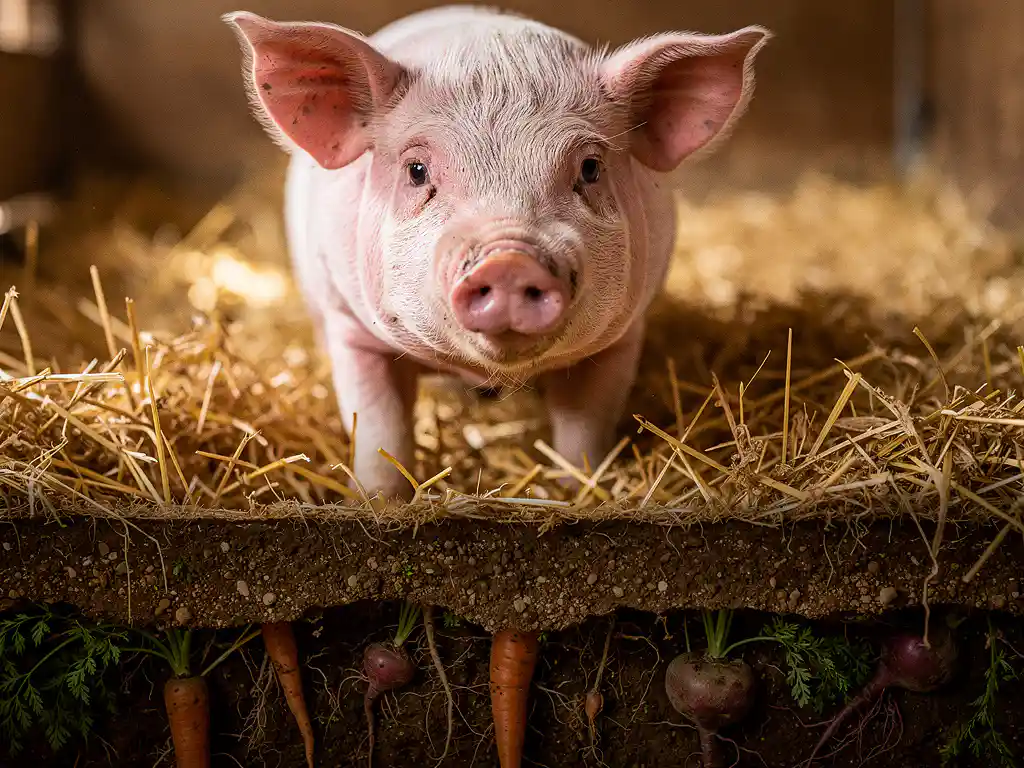
The most effective measures against heat stress in livestock are a combination of environmental modifications, adequate water supply and targeted nutritional support. Cooling, shade and ventilation directly reduce heat stress, while electrolytes and nutritional supplements such as betaine enhance animals’ physiological resilience. In this article, we answer the most frequently asked questions about heat stress in livestock, from recognition to economic impact.
How do you notice that your animals are suffering from heat stress?
Animals with heat stress show clearly identifiable behavioral changes and physiological signals. They breathe faster and shallower, seek shade, drink more water and move less. In cows, milk production decreases noticeably, in pigs feed intake decreases, and in poultry you will see wings held away from the body to lose heat.
Heat stress in livestock occurs when the animal’s heat production exceeds its heat release to the environment. Thresholds vary by animal species. Cows begin to suffer at a temperature-humidity index (THI) above 68, while pigs and poultry are more sensitive to combinations of high temperature and high humidity.
Concrete signals by species:
- Cows: increased respiratory rate, salivation, less rumination, lower milk production, fertility problems
- Pigs: decreased feed intake, lethargy, reddening of skin, increased mortality in severe cases
- Poultry: panting with open beak, wings spread away from body, fewer eggs, thinner eggshells, increased failure rate
- Sows: poorer reproduction results, fewer piglets born alive, lower birth weight
Early intervention is crucial. Once you recognize these signs, heat stress is often already several hours away. Regular monitoring of barn temperature, humidity and animal behavior during hot periods helps you catch problems early.
Which environmental measures reduce heat stress the fastest?
Ventilation and cooling are the quickest and most direct environmental measures against heat stress in livestock. Increased air velocity via fans significantly lowers the wind chill for animals. Combined with misting systems or sprinklers, effective barn temperatures can drop several degrees in a short period of time.
The most impactful environmental interventions in a row:
- Increase air circulation: Tunnel ventilation or additional fans decrease wind chill. An air velocity of 2 to 3 meters per second has a significant cooling effect on animals.
- Misting systems: Fine water droplets evaporate into the air and cool the environment. Note: In high humidity, this is less effective and can promote mold growth.
- Provide shade: Both in pastures and outdoor runs, shade greatly reduces direct radiation exposure. Trees, shade cloths or canopies are simple interventions with great effect.
- Adjust stocking density: Fewer animals per square meter means less heat production per unit area and more space for air circulation.
- Insulation and reflective roofing: Light or reflective roofing reduces solar heat radiation and keeps barn temperatures structurally lower.
In poultry, tunnel ventilation is the most proven method. In cattle, sprinklers above the waiting area for milking are a particularly effective measure because cows are waiting there anyway and cooling intervenes immediately at the moment of maximum heat load.
How does heat stress affect feed intake and what helps against it?
Heat stress reduces feed intake in all animal species because the digestive process itself produces heat and animals instinctively eat less to reduce overheating. In dairy cows, dry matter intake can decrease by 10 to 20 percent during heat stress, leading directly to energy deficiency, weight loss and lower production.
Reduced feed intake has a chain effect: less energy intake leads to impairment of body condition, weaker immunity and, in sows, poorer reproductive results. At the same time, the animal’s maintenance requirements increase due to the additional energy required for thermoregulation.
Practical measures to maintain feed intake during hot periods:
- Provide feed in the early morning and late evening, when temperatures are lowest
- Offer fresh, palatable feed and remove old feed in a timely manner
- In ruminants: increase the energy density of the ration so that less volume is required for the same energy intake
- Increase feeding frequency to keep feed more attractive
- For TMR: change feed more frequently to prevent heating and scalding
Betaine plays an interesting role here. As an osmolyte, it helps stabilize cellular water balance, which lowers energy requirements for cell maintenance. In ruminants, there is evidence that betaine supports dry matter intake, in part by stimulating microbial protein production in the rumen. In beef pigs and poultry, betaine helps maintain technical performance, especially during periods of heat stress.
What role do water and electrolytes play in combating heat stress?
Water is the most important and immediate protection against heat stress in livestock. Animals experiencing heat stress drink up to twice as much water as normal. Insufficient water supply quickly worsens stress and leads to dehydration, reduced production and, in severe cases, mortality.
In addition to adequate water supply, electrolytes are lost through sweat and increased respiration during heat stress. Potassium, sodium and magnesium are the main electrolytes that need to be replenished. Potassium deficiency in dairy cows is a known trigger for milk fever and muscle weakness during hot periods.
Considerations for water supply during heat stress:
- Provide enough watering holes so that all animals can drink at the same time
- Keep water as cool as possible; hot water is less liked to be drunk
- Clean drinking bowls more often, as bacterial growth accelerates in warm water
- Add electrolytes to drinking water during prolonged heat
- Monitor water intake as an early indicator of heat stress
Drinking water is also an excellent delivery vehicle for supplementary substances. During times of stress or illness, water intake is more reliable than feed intake, and dosing via drinking water is fully controllable. This makes it easy to administer drinking water and feed additives based on betaine and vitamin C when the animals need them most.
When are nutritional supplements useful in heat stress?
Dietary supplements are useful in heat stress when environmental measures alone are not sufficient to cope with the physiological stress. This is the case during prolonged heat periods, in animals with high production, in sows in late gestation or early lactation, and in poultry in full production. Supplements support cell function, reduce oxidative stress and help maintain production and reproduction levels.
The most substantiated nutritional supplements for heat stress are:
- Betaine: as an osmolyte, it protects cells from dehydration and heat damage, lowers maintenance requirements and supports gut integrity. In poultry, betaine improves breast muscle weight and carcass quality under heat stress via improved cellular hydration and antioxidant protection.
- Vitamin C: an antioxidant that is more rapidly consumed under heat stress. Supplementation via drinking water supports immunity and metabolism. Pure C Beta combines vitamin C with betaine for a combined approach.
- Vitamin E and selenium: protect cell membranes from oxidative damage that increases with heat stress.
- Electrolytes: potassium, sodium and magnesium compensate for losses through respiration and perspiration.
- Organic acids and essential oils: support intestinal health, which is especially vulnerable during heat stress due to reduced blood flow to the gastrointestinal tract.
In sows, the evidence for betaine is particularly strong during heat stress periods, especially during summer mating and late pregnancy. Studies show that betaine supplementation positively affects the number of piglets born alive and supports milk quality. In ruminants, betaine stimulates microbial protein production in the rumen and supports osmotic balance, even when the rumen itself breaks down some of the betaine.
What is the economic impact of heat stress on livestock farms?
Heat stress causes significant economic damage in livestock production, through lower production, poorer reproduction results, higher failure rates and additional costs for cooling measures. In dairy farms, heat stress leads to direct production losses through lower milk yields, as well as indirect damage through deteriorated fertility and longer inter-calving time.
The economic impact is broad and touches multiple aspects of the business simultaneously:
- Dairy farming: lower milk production, poorer milk composition, increased cell counts, fertility problems and higher animal costs
- Pig farming: reduced growth in fattening pigs, poorer feed conversion, higher piglet failure rates and fewer piglets born alive per sow
- Poultry farming: fewer eggs per hen, thinner eggshells, lower carcass yield, higher mortality and poorer feed conversion ratio
Heat stress is not an incident but a structural risk. Hot summers are becoming more frequent and intense, meaning that cumulative damage over several years can be significant. Preventive investments in cooling, water infrastructure and nutrition support make good economic sense if they prevent structural loss of production.
The payback period for targeted measures is usually short. A higher water intake, better feed utilization and less downtime soon outweigh the costs of supplements or infrastructure modifications. Livestock farmers who structurally address heat stress not only protect their animals but also the continuity and profitability of their farms.
How Jodoco helps with heat stress in livestock
We at Jodoco have been developing science-based solutions to precisely the challenges posed by heat stress for more than 25 years. Our portfolio focuses on strengthening the physiological resilience of animals so that they perform better even when conditions are difficult.
Our approach to heat stress combines multiple mechanisms of action in targeted formulations:
- Betaine as an osmolyte: protects cells from dehydration and heat damage, lowers maintenance court and supports intestinal integrity in all animal species. Learn more about how betaine works in heat stress on our website.
- Pure C Beta: combines vitamin C with betaine for enhanced immunity and optimal hydration, easily administered via drinking water for 2 to 5 consecutive days.
- Jodobet: our flagship product based on natural betaine, proven effective in broilers, layers, pigs and ruminants. Jodobet supports heat tolerance, carcass quality and reproductive performance.
- Grovax: a liquid source of organic acids, butyrate, MCFA and essential oils that strengthens gut health even under the challenge conditions that heat stress creates.
Whether you are a compound feed manufacturer, distributor or professional livestock farmer, we are happy to work with you on a strategy that fits your business situation and goals. Contact us and find out which approach makes the most difference for your animals and your results.