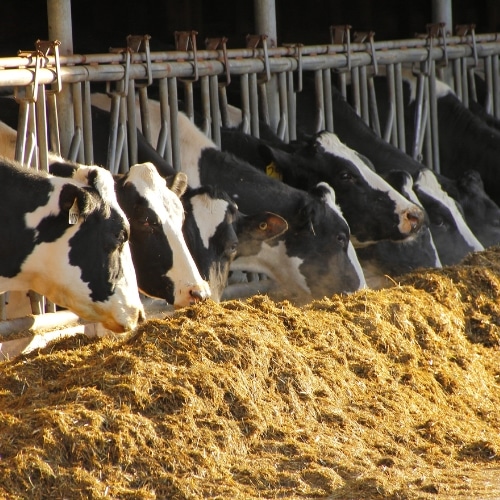
Betaine helps regulate body temperature by protecting cells against osmotic stress and reducing the energy demand for osmoregulation. As a compatible osmolyte, betaine stabilizes cell hydration, allowing animals to waste less energy maintaining their internal water balance during hot periods. In this article, we answer the most frequently asked questions about betaine, heat stress, and its practical application in livestock farming.
How does heat stress affect the physiology of farm animals?
Heat stress occurs when the ambient temperature exceeds an animal’s thermoneutral zone and the body can no longer compensate for heat production through normal cooling mechanisms. This disrupts the osmotic balance within cells, increases the energy demand for thermoregulation, and leads to measurable declines in production, fertility, and disease resistance.
When animals experience heat stress, they redirect energy from productive functions toward cooling. In poultry, this manifests as reduced feed intake, lower egg production, and poorer shell strength. In pigs, heat stress leads to reduced daily gain and impaired fertility in sows, particularly during summer mating and late gestation. In ruminants, milk production drops and feed conversion efficiency deteriorates.
At the cellular level, heat stress causes a rise in intracellular salt concentration, which destabilizes proteins and compromises the integrity of cell membranes. The intestinal barrier is particularly vulnerable: heat stress reduces the expression of tight junction proteins such as occludin and claudin-1, increasing intestinal wall permeability. This raises the risk of secondary infections and inflammation. The combination of reduced feed intake, increased maintenance requirements, and a weakened intestinal barrier makes heat stress one of the most costly challenges in professional livestock farming.
How does betaine help regulate body temperature?
Betaine supports thermoregulation in animals by acting as a compatible osmolyte: when a cell experiences osmotic stress, it moves from the extracellular fluid into the cytosol, attracting water molecules and stabilizing proteins without interfering with normal cellular processes. This reduces the energy demand for osmoregulation via ion pumps, where each active ion transport event consumes one unit of ATP.
Betaine also forms a hydration shell around proteins, preventing denaturation. This is particularly important in the kidneys, liver, and intestinal epithelial cells, which are placed under the greatest strain during heat stress. By maintaining the water balance within cells, betaine preserves energy that would otherwise be lost compensating for osmotic disruptions.
Beyond its role as an osmolyte, betaine acts as a potent methyl donor, contributing to the synthesis of carnitine, which stimulates fat oxidation in the mitochondria. This provides additional energy for protein deposition and maintenance — precisely when feed intake declines due to heat. The combined effect of osmotic protection and improved energy utilization makes betaine a scientifically supported strategy against heat stress in farm animals. Learn more about how natural betaine works on our website.
What are the measurable effects of betaine during heat stress?
During heat stress, betaine supplementation delivers measurable improvements in growth, carcass quality, reproduction, and gut health. Research consistently shows that animals receiving betaine under heat stress exhibit higher breast muscle yield, better feed conversion ratios, and reduced body fat deposition compared to unsupplemented control groups.
The effects vary by species, but the underlying mechanisms are comparable:
- Poultry: Higher breast muscle yield and improved carcass weight, better egg production and shell strength in laying hens, less wet litter due to improved gut integrity
- Finishing pigs: Improved heat tolerance, higher lean meat gain, reduced drip loss, and better carcass composition
- Sows: Reduced late-gestation losses, higher numbers of live-born piglets, and better milk quality during hot periods
- Ruminants: Osmotic support during heat stress, higher milk production, and improved fiber digestion through stimulation of microbial protein synthesis
- Weaned piglets: Lower incidence of diarrhea, more stable osmotic balance in the gut, and faster recovery from the weaning dip
A study published in the Journal of Thermal Biology (Elsherbeni et al., 2025) confirmed that betaine improves breast muscle weight in broilers under heat stress through enhanced cellular hydration and antioxidant protection. Scientific research by Wettere et al. (2012, Animal Reproduction Science) demonstrated that betaine supplementation in pregnant sows tended to reduce late-gestation losses and increased the number of live-born piglets by an average of 0.5.
How does betaine differ from other heat stress additives?
Betaine stands apart from other heat stress additives because it simultaneously fulfills three physiological functions: osmotic cell protection, methyl donation, and energy metabolism. Most other additives target only a single mechanism, such as electrolyte replacement or antioxidant support, without restoring the underlying cellular energy balance.
A commonly used alternative is choline chloride, which is partially converted to betaine in the liver. However, that conversion has an efficiency of only 50 to 60 percent. In addition, choline chloride carries several disadvantages that betaine does not:
- Choline chloride is highly hygroscopic and absorbs moisture, causing clumping in premixes
- It is chemically reactive and destroys vitamins A, D3, K3, B1, B2, and B12 in premixes
- It promotes oxidation of trace elements and shortens the shelf life of compound feeds
- It contains high levels of trimethylamine (TMA, exceeding 600 ppm), which causes a fishy odor and negatively affects palatability
- Ionophores further reduce the conversion of choline to betaine in the body
Synthetic betaine HCl also has drawbacks compared to natural betaine: it raises total dietary chloride levels, disrupts the electrolyte balance, and has been shown in research to produce weaker tight junctions in the TEER model. Natural betaine, derived as a byproduct of sugar beet processing, has a lower carbon footprint and demonstrably outperforms synthetic alternatives in heat stress studies with broilers.
When and how should betaine best be administered during heat stress?
Betaine is most effective against heat stress when administered preventively — that is, before or at the onset of hot periods — rather than only after a production decline has already become apparent. Administration via feed as well as via drinking water is possible; during periods of stress, drinking water is the preferred route because water intake is more reliable than feed intake.
For feed administration, a dosage of 1,000 to 2,000 mg of betaine per kg of feed is standard, depending on the animal species and the severity of heat stress. Betaine is heat-stable up to 200 degrees Celsius and can be added at any stage of the mixing, conditioning, and pelleting process without loss of efficacy.
For administration via drinking water, a liquid combination of betaine with organic acids offers additional benefits: the organic acids lower the pH in the stomach, combat gram-negative bacteria such as E. coli and Salmonella, and provide a supplementary energy source. A product such as Jodoplume combines these active ingredients in a single drinking water solution and can be used from week three onward, for three to four days per week during heat or coccidiosis stress. The drinking water dosage is one to two liters per 1,000 liters of drinking water for all animal species.
The most effective use of betaine during heat stress is therefore a combination of structural supplementation via feed and targeted top-up via drinking water on the hottest days, ensuring continuous osmotic protection.
How Jodoco helps with betaine during heat stress
At Jodoco, we have developed betaine as a core component of our product portfolio, specifically addressing the challenges that professional livestock farmers and growers face on a daily basis. Our heat stress solutions are scientifically substantiated, produced at our own facility in Tienen, and based on natural betaine derived from non-GMO sugar beets.
What we offer for heat stress in livestock farming:
- Jodobet as our core product: natural betaine for inclusion in feed, heat-stable and effective as both an osmolyte and methyl donor
- Jodoplume: a liquid drinking water combination of betaine, organic acids, and copper, targeting heat stress and coccidiosis
- Custom formulations for compound feed manufacturers, wholesalers, and professional livestock operations
- Technical support and scientific guidance during implementation
- A proven portfolio deployed across multiple international markets
Would you like to know which betaine solution best fits your operation or production line? Contact us and we will be happy to work with you on a targeted approach to heat stress in your sector.