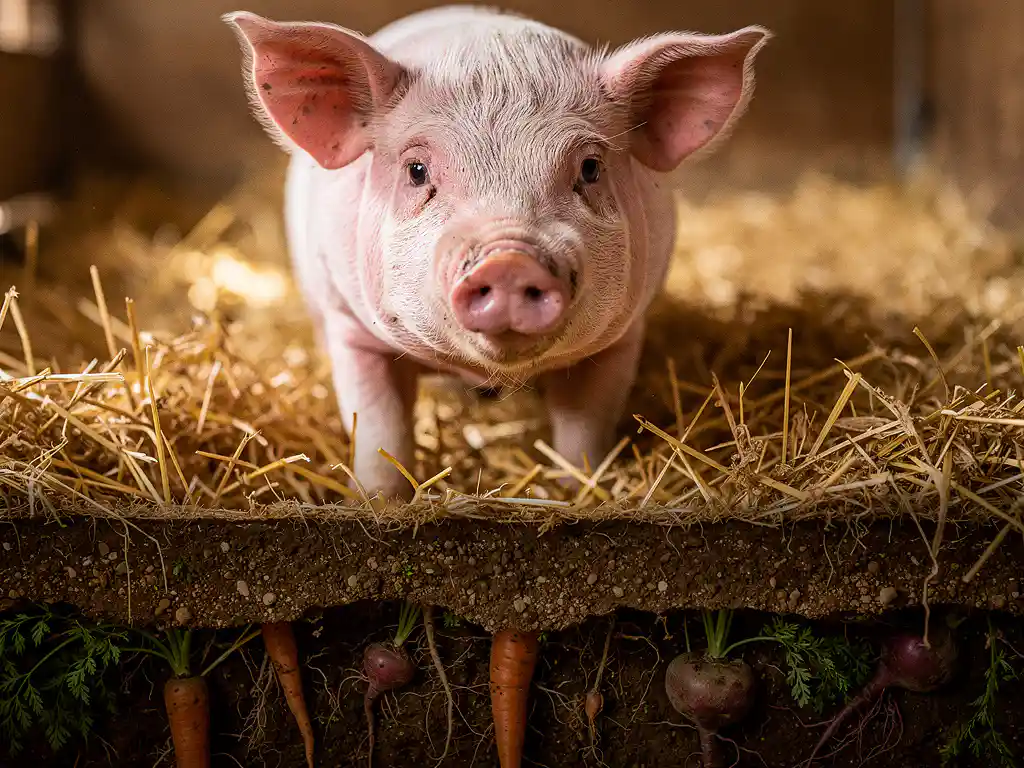
Betaine supports bone health in young animals through its role as a methyl donor and osmolyte. By making methyl groups available for essential metabolic processes, betaine contributes to the synthesis of substances directly involved in bone formation and mineral utilization. The following questions explore each aspect of that relationship in depth, from the biochemistry to practical application in the barn.
What role does methyl donation play in bone development in young animals?
Methyl donation is a fundamental biochemical process in which methyl groups are transferred to other molecules, and betaine is one of the most efficient methyl donors in animal metabolism. In young animals, this function supports the synthesis of creatine, carnitine, and phosphatidylcholine — substances that directly or indirectly contribute to bone formation, muscle mass, and energy balance during the rapid growth phase.
Through the transmethylation cycle, also known as one-carbon metabolism, betaine donates three methyl groups. It remethylates homocysteine to methionine via the enzyme BHMT. Methionine is then converted to S-adenosylmethionine (SAM), the universal methyl donor for hundreds of reactions in the body. An adequate supply of SAM is essential for the synthesis of collagen, a structural protein that gives bone tissue its strength.
When methyl donors are deficient, young animals show reduced DNA methylation, increased liver inflammation, and disrupted fat metabolism. All of these factors indirectly inhibit normal skeletal development, because energy and building blocks are then not optimally available for bone mineralization. Young animals in the growth phase, during which the bone matrix is rapidly being built, are particularly vulnerable to these kinds of metabolic bottlenecks.
Betaine is also approximately twice as effective as choline as a methyl donor. This means that a relatively low dose already makes a meaningful contribution to the methyl donor potential in the feed, without requiring large amounts of choline or methionine.
How does betaine affect the absorption of calcium and phosphorus?
Betaine improves the absorption of calcium and phosphorus indirectly by optimizing gut health. A healthy intestinal wall with high villus height and shallow crypt depth offers a greater absorption surface, which significantly increases the utilization of minerals such as calcium and phosphorus. This is crucial for bone mineralization in young animals.
Scientific research shows that betaine increases villus height and reduces crypt depth. A larger absorption surface means that minerals remain in contact with the intestinal wall for longer and more intensively, making absorption more efficient. Calcium and phosphorus are the two most critical minerals for bone formation, and insufficient absorption directly leads to weaker bones and a higher risk of skeletal abnormalities.
In addition, betaine promotes a healthy microbiome balance in the gut, also known as eubiosis. A stable microbiome with a dominance of beneficial bacteria supports the production of short-chain fatty acids such as butyrate, which strengthen the intestinal barrier. An intact intestinal barrier prevents toxins and pathogens from disrupting mineral absorption.
Finally, betaine acts as an osmolyte to protect intestinal epithelial cells against osmotic stress. When cells are under pressure from dehydration, heat, or high salt concentrations, the active transport mechanisms responsible for mineral absorption are disrupted. By stabilizing cell tonicity, betaine keeps these transport processes functioning properly, even under challenging conditions.
Which young animal species benefit most from betaine for bone health?
Young broilers, piglets, and turkeys benefit most from betaine for their skeletal development, because these species go through a very rapid growth phase during which the demand for methyl donors and minerals is high. In fast-growing breeds, the risk of skeletal problems is greatest when the diet does not fully meet the metabolic requirements.
In broilers, the growth rate is so high that bone development can sometimes lag behind muscle mass. This leads to leg disorders and locomotion problems — a well-known issue in poultry farming. Betaine supports both the methyl donation function and gut health here, helping to maintain an adequate supply of building blocks for the skeleton.
In young piglets after weaning, the transition to solid feed is a stressful period for the gut. Reduced intestinal integrity during this phase directly limits the absorption of calcium and phosphorus. Betaine as an osmolyte protects intestinal cells during this transition and thereby supports bone mineralization during a vulnerable growth phase.
In turkeys, choline requirements are high — up to 1,600 mg per kg of feed for breeding animals. Betaine can take over part of the methyl donor function of choline, thereby reducing the metabolic burden on the liver, which indirectly benefits the availability of building blocks for bone tissue.
What are the signs of poor bone health in young animals?
Poor bone health in young animals manifests in a recognizable pattern of clinical and behavioral signs. The most common signs are locomotion problems, limb deformities, increased mortality, and stunted growth. Early recognition is essential, as skeletal problems rarely resolve on their own and can significantly affect the technical performance of a flock or group.
The following signs indicate skeletal problems in young animals:
- Lameness or reluctance to walk, even without visible wounds
- Bending or rotation of the legs in poultry (valgus deformities)
- Soft or flexible bones upon examination or post-mortem
- Increased mortality without a clear infectious cause
- Growth lag relative to the breed standard
- Increased susceptibility to fractures during handling or catching
- Poor feathering or rough appearance as a result of metabolic stress
In broilers, tibial dyschondroplasia is a common condition in which the cartilage in the growth plate fails to ossify properly. In piglets, osteoporosis-like signs are regularly observed after weaning when mineral utilization is inadequate. In turkeys, leg problems are one of the leading causes of early mortality.
It is important to emphasize that skeletal problems rarely have a single cause. In addition to nutritional deficiencies, stocking density, litter quality, and genetics also play a role. However, a nutritional strategy that optimizes gut health and methyl donation always provides a solid foundation for prevention.
How does betaine differ from synthetic methionine for bone health?
Betaine and synthetic methionine both play a role in one-carbon metabolism, but they work through different mechanisms and complement each other. Synthetic methionine provides the amino acid chain needed for protein synthesis and methyl donation via SAM, while betaine directly remethylates homocysteine to methionine, making the methyl donor cycle more efficient without functioning as an amino acid itself.
An important practical difference is that betaine can spare methionine. When betaine takes over the remethylation of homocysteine, less methionine is needed for that step in the transmethylation cycle. The freed-up methionine can then be used for protein deposition and tissue synthesis, including the formation of bone matrix and cartilage.
Synthetic methionine has no direct osmoregulatory effect. As a compatible osmolyte, betaine protects the cells of the kidneys, liver, and intestines against heat and osmotic stress — a function that methionine cannot fulfill and that is particularly valuable for mineral absorption in young animals under warm conditions or during weaning stress.
Betaine does not fully replace methionine. The two substances operate in a complementary manner: methionine remains necessary for protein synthesis and the first step in the transmethylation cycle, while betaine accelerates that cycle and increases its efficiency. In practice, a combination of both yields better technical results than either one alone, including for skeletal development.
What doses of betaine are effective for skeletal development?
For a noticeable effect on gut health, methyl donation, and indirect support of bone mineralization, doses of 500 to 1,000 mg of betaine per kg of feed are common in practice. Scientific research in broilers shows that 420 mg per kg of feed already leads to clearly improved technical performance, including better feed conversion and higher growth rates.
The optimal dose depends on the species, the life stage, and the presence of stress factors:
- Broilers: 300 to 500 mg of betaine per kg of feed for methyl donation purposes; up to 1,000 mg per kg of feed during heat stress or coccidiosis pressure
- Turkeys: 500 to 1,000 mg per kg of feed, depending on the growth phase and the choline content of the base diet
- Growing pigs: 400 to 600 mg per kg of feed in line with standard recommendations; consider higher doses during weaning stress
- Gestating and lactating sows: 600 to 1,000 mg per kg of feed, where the methyl donor function contributes to fetal development and bone formation in piglets after birth
Natural betaine, such as that derived from sugar beets, is heat-stable up to 200 degrees Celsius. This means it can be added without loss of efficacy at any stage of the mixing, conditioning, and pelleting process. This is a practical advantage over certain other additives that are sensitive to heat during processing.
It is advisable to align the dose with the choline content of the base diet. Betaine covers only the methyl donor function of choline, which corresponds to approximately 50 percent of the total choline requirement. In a diet that already contains sufficient choline for membrane synthesis and neurotransmission, betaine serves as a supplement for the methyl donation function.
How Jodobet supports bone health in young animals
We develop and produce Jodobet, our natural betaine derived from non-GMO sugar beets, specifically for applications in animal nutrition where methyl donation, gut health, and stress protection are central. For the bone health of young animals, Jodobet offers concrete added value on multiple levels:
- Efficient methyl donation that supports the transmethylation cycle, promoting the production of carnitine, creatine, and collagen
- Improvement of villus height and reduction of crypt depth for better absorption of calcium and phosphorus
- Osmoregulatory action that protects intestinal epithelial cells during heat or weaning stress, maintaining mineral transport
- Heat stability up to 200 degrees Celsius, ensuring efficacy is retained after pelleting
- No vitamin degradation in premixes, unlike choline chloride
Jodobet is available in liquid form (L35) and as a crystalline powder (D96/D97), making it easy to integrate into existing feed formulations for poultry, pigs, and ruminants. Want to know which dose and formulation best suits your specific situation? Contact us for a personalized consultation.