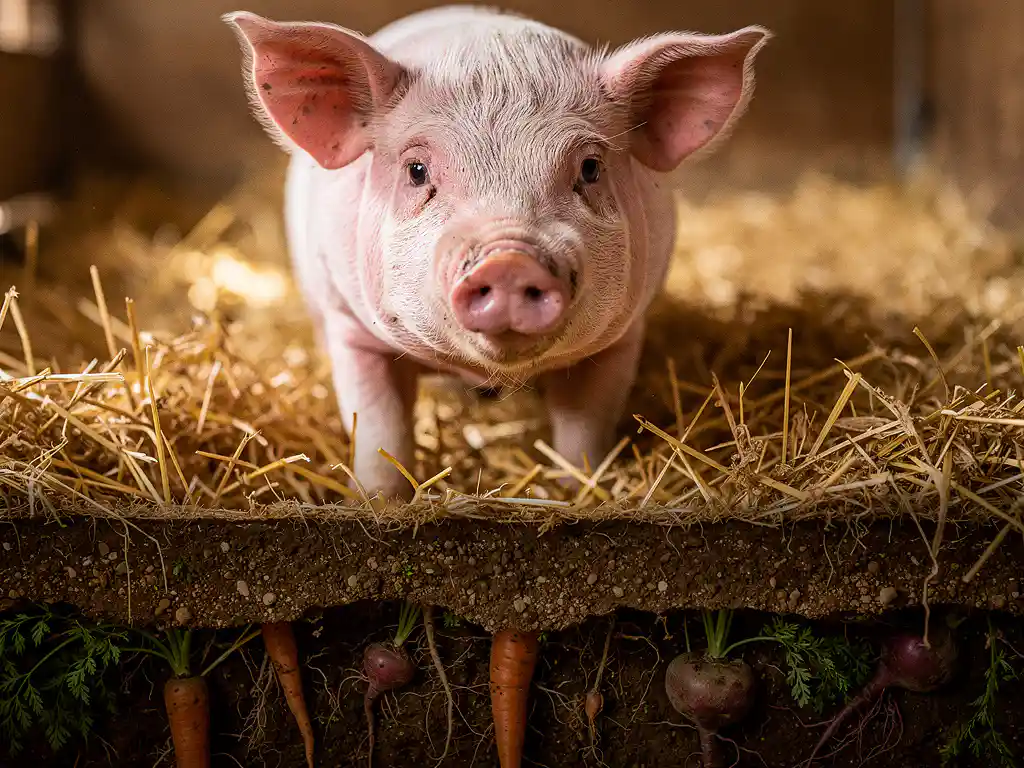
Yes, betaine has been shown to improve digestion in animals. This natural substance, derived from sugar beets, supports gut health through multiple mechanisms: as an osmolyt, it protects intestinal epithelial cells from stress, and as a methyl donor, it contributes to healthy cellular metabolism. The questions below explain exactly how this works and when betaine is most effective.
How does betaine work in the digestive tract of animals?
Betaine improves digestion by protecting the integrity of the intestinal wall and supporting nutrient absorption. As a compatible osmolite, betaine attracts water molecules into the intestinal epithelial cells, stabilizes proteins, and maintains cell function. This is particularly relevant in the small intestine, where the absorption of amino acids, fats, and minerals takes place.
Betaine strengthens the so-called tight junctions—the connections between intestinal cells that prevent harmful bacteria and toxins from leaking through the intestinal wall. When this barrier weakens, it is referred to as a leaky gut, which leads to inflammation, reduced feed conversion, and increased susceptibility to infections. Research using the TEER model shows that natural betaine maintains the intestinal barrier significantly more effectively than synthetic alternatives such as betaine-HCl.
In addition, betaine plays a role in combating coccidiosis. In coccidiosis challenge models, natural betaine restored nutrient digestibility more effectively than synthetic betaine-HCl. This makes betaine a valuable component of a gut health strategy, even when combined with other additives such as organic acids.
What is the role of betaine as a methyl donor in metabolism?
As a methyl donor, betaine provides three methyl groups that are essential for hundreds of biochemical reactions in the animal body. Through the transmethylation cycle, betaine remethylates homocysteine to methionine, which is then converted to S-adenosylmethionine (SAM), the universal methyl donor for processes such as the synthesis of creatine, carnitine, and phosphatidylcholine.
A shortage of methyl donors has concrete consequences for animal health and performance:
- Reduced methylation of DNA
- Increased risk of liver inflammation
- Reduced liver oxidation and impaired fat metabolism
- Slower growth and poorer feed conversion
As a methyl donor, betaine is about twice as effective as choline. Important to know: betaine cannot be converted to choline, which means it supports only one of choline’s four functions—namely, its role as a methyl donor. However, this accounts for about 50% of the total choline requirement. In cases of marginal choline deficiency, supplementation with betaine is therefore particularly effective.
Which animal species benefit most from betaine?
Poultry and swine benefit most from betaine in terms of digestion, but ruminants also respond positively. In broilers and laying hens, the effects on growth, feed conversion, and carcass quality are best supported by scientific evidence. In pigs, betaine plays a role in protein synthesis and the reduction of fat deposition.
Scientific research on broiler chickens, conducted by ILVO Ghent and Schothorst Feed Research, among others, confirms that betaine improves technical performance, particularly at a dosage of around 420 ppm. The best results are achieved when animals are exposed to stress factors such as heat, high stocking density, or infection pressure.
In ruminants such as dairy cows, betaine helps prevent fatty liver and ketosis, particularly around the time of calving. Products that combine betaine with rapidly available carbohydrates and glycerol, such as Acibet G, have been specifically developed for this application. Trial results show that cows receiving daily betaine supplements are better able to maintain their milk production, even with a reduced concentrate ration.
Can betaine help alleviate heat stress and osmotic stress in animals?
Yes, betaine is a proven osmolyt that protects animals against both heat stress and osmotic stress. When cells experience osmotic pressure, betaine moves from the extracellular fluid into the cytosol, attracts water molecules, and stabilizes proteins. This reduces the energy required for osmoregulation via ion pumps, as each active ion transport costs one unit of ATP.
Betaine also forms a hydrating layer around proteins, which prevents denaturation caused by heat. This is particularly relevant in the kidney, liver, and intestinal epithelial cells, which are subjected to significant stress at high temperatures. In practice, this means that during hot periods, animals lose less energy to cell stabilization and can better utilize that energy for growth and production.
Studies in broiler chickens under heat stress confirm that natural betaine improves breast meat yield, body weight gain, and feed efficiency more effectively than synthetic betaine-HCl. For use in drinking water during heat stress, combination products of betaine and organic acids offer a practical solution.
How does betaine differ from other digestive-support additives?
Betaine differs from other digestive additives in that it acts simultaneously as an osmolyt, a methyl donor, and a carcass modifier. Organic acids, enzymes, and probiotics each have a specific mode of action, but none of them combine those three functions in a single molecule. Betaine acts systemically, whereas organic acids and essential oils are primarily active locally in the gastrointestinal tract.
Compared to choline chloride, the most commonly used alternative as a methyl donor, betaine offers a number of specific advantages:
- Betaine does not destroy vitamins (A, D3, K3, B1, B2, B12) in premixes, but choline chloride does
- Betaine is not hygroscopic and does not cause clumping
- Betaine does not have a fishy odor due to its low TMA levels; choline chloride, however, can cause this odor
- Betaine has a lower carbon footprint than synthetic alternatives
- Betaine is heat-stable up to 200°C and can be added at any stage of the mixing process
When betaine is combined with organic acids, essential oils, or butyrate—as in products such as Grovax—their mechanisms of action reinforce one another. Organic acids lower the pH in the stomach and kill Gram-negative bacteria, while betaine protects intestinal integrity and supports cellular metabolism.
When and how is betaine best used in animal feed?
Betaine works best when animals are exposed to stressors such as heat, infection pressure, a diet low in methyl donors, or high production pressure. The optimal dosage in poultry feed is around 1,000 to 2,000 mg of betaine per kilogram of feed, depending on the production goal and the presence of stress factors.
For practical application, there are two main approaches:
- Through the feed: betaine in powder or liquid form is added during the mixing or pelletizing process. Natural betaine is heat-stable up to 200°C, allowing it to be incorporated at any stage of production without losing its efficacy.
- Via drinking water: combination products containing betaine and organic acids are suitable for short-term use during heat stress or coccidiosis outbreaks, typically for three to four days per week.
For more information about the scientific background of betaine and its potential applications in animal feed, please visit our page on betaine.
How Jodobet Aids Animal Digestion
We developed Jodobet as our flagship product based on natural betaine, derived as a byproduct of sugar beet processing. Jodobet combines all three physiological functions of betaine into a single, scientifically validated product:
- Gut health: protects the intestinal wall, strengthens tight junctions, and improves nutrient absorption
- Stress resistance: a proven osmolyt that reduces heat stress and stabilizes water balance in cells
- Metabolic support: an effective methyl donor that prevents vitamin degradation in premixes and improves carcass quality
- Versatile use: suitable for both feed and drinking water, heat-resistant up to 200°C, available in liquid and dry forms
Our products are developed in our own laboratories and validated in collaboration with national and international research institutions. Whether you’re a feed manufacturer, distributor, or professional livestock producer, we’re happy to work with you to determine the best approach for your situation. Contact us and discover what betaine can do for your business.